What caused your tile or coping failure?
No votes yet. Yours will be the first. · saved on this device
Loading...
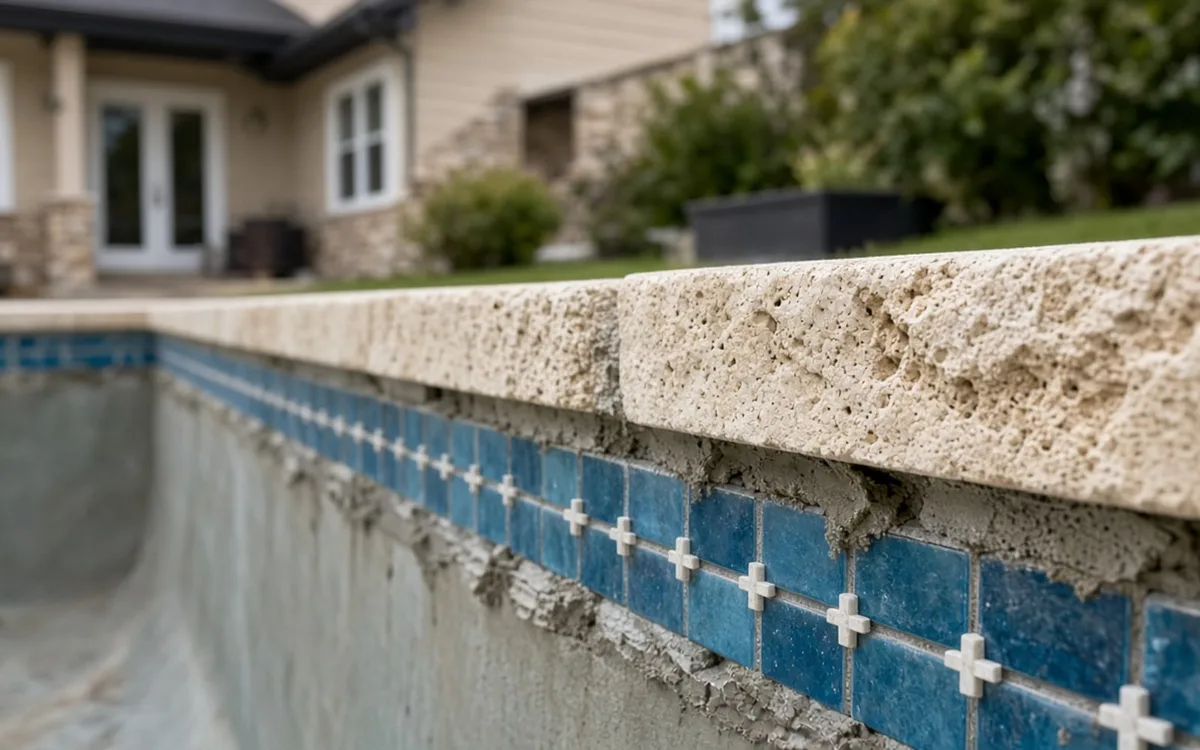
Pool Renewal Notes · Waterline retile only vs Full interior retile
Retile only the waterline when the interior finish is sound and the goal is to fix popped, scaled or dated tile; it costs Shasta Pools' $25 to $30 per linear foot with the water lowered, not drained. Choose a full interior retile only for a stable shell, a long ownership horizon and a premium budget, since it requires a full drain and costs several times more.
Waterline tile is the most visible band in the pool and the one that takes the most abuse from sun, scale, splash and ice. A full tile interior is the most durable surface a pool can have, but also the most demanding to install and the least forgiving of a shell that moves. The decision usually comes down to the condition of the shell and the owner's horizon, with appearance a close third.
This page covers owner scenarios, lifetime cost, climate, shell stability, resale, common mistakes and how to compare tile bids. The tile and coping page covers the repairs underneath the tile, including the bond beam and the expansion joint, which decide how long either option lasts. The comparison table gives the short version.
Waterline retiling replaces the 6-inch band at the bond beam for Shasta's $25 to $30 per linear foot with the water lowered, not drained. A full interior retile replaces every surface in tile at We Fix Ugly Pools' $15,000 to $30,000 or more for 500 square feet, is the longest-lasting interior, and requires a full drain and a sound shell.
| Factor | Waterline retile only | Full interior retile |
|---|---|---|
| Upfront cost | $1,500 to $2,500 for a 10 x 20 pool (Shasta 2026); $1,200 to $6,000 for 60 to 100 ft (We Fix Ugly Pools 2026) | $15,000 to $30,000+ for 500 sq ft (We Fix Ugly Pools 2026); $3,000 to $20,000 range (HomeAdvisor 2026) |
| Lifespan | 15+ years on a sound beam with a working joint | Longest of any interior (HomeAdvisor); grout is the maintenance item |
| Maintenance | Brush the waterline weekly; descale periodically | Grout cleaning and sealing; scale on horizontal surfaces |
| Appearance | Refreshes the most visible band | Any pattern or color; premium look |
| Climate fit | Frost-rated tile and epoxy grout in freeze regions | Glass tile is a freeze risk; needs a flat, stable shell |
| Time out of service | 3 to 5 days with water lowered | 1 to 2 weeks fully drained plus cure |
| Resale / ROI | High visual return per dollar | Luxury signal; buyers may not pay full cost back |
| Best for | Popped or scaled waterline tile on a sound finish | A sound shell, a long ownership horizon and a premium budget |
Waterline retile wins almost every time the interior finish below it is sound. It is the cheapest visible renovation a pool can get, it is done without draining, and paired with an expansion joint reset it lasts as long as the beam stays still. Shasta calls it the affordable fix for calcium scale and cracked tile, and it is the first thing a buyer's eye lands on.
Full retile wins for an owner who wants tile's longevity and look, accepts five to six times the cost of plaster per HomeAdvisor, and has a shell with no movement history, since tile shows every void and crack behind it. On a freeze-climate pool or a beam that has moved, the tile and coping page explains why a waterline band in frost-rated porcelain is the safer spend.
Popped or cracked waterline tile on an otherwise sound pool is the most common case, followed by calcium scale so heavy that bead-blasting cannot restore the glaze, and dated tile an owner simply wants to refresh. If the interior finish below is smooth and the pool holds water, the band can be replaced with the level dropped a foot or two, which avoids a full drain, a refill and any groundwater risk.
A waterline retile is also the classic pre-sale refresh. Paired with LED lights and a thorough cleaning, it can make an older pool photograph as renovated for a modest budget, because the tile line is the first thing the eye lands on. Shasta Pools prices waterline tile at $25–$30 per linear foot against about $15,000 for a full tile job, and a band instead of a full retile is the cheaper choice that still reads as renovated. The key condition is that the bond beam behind the tile is stable and the expansion joint between coping and deck is cut out and resealed as part of the job.
Shasta prices waterline tile at $25–$30 per linear foot, and We Fix Ugly Pools puts waterline retiling at $15–$60 per linear foot depending on tile choice, with glass and specialty tile at the top of that range. For a full interior, HomeAdvisor lists pool tile installation at $3,000–$20,000 across scopes, and We Fix Ugly Pools prices a 500 square foot full retile at $15,000 to $30,000 or more.
A full tile interior can outlast several cementitious resurfacings, which is its main economic argument; HomeAdvisor describes tile as the longest-lasting interior. But the upfront cost is several times a pebble finish, and the payback arrives only over a long ownership. For most owners, a waterline band on top of a durable plaster, quartz or pebble interior is the better value per year of service. The band can be renewed on its own schedule without draining.
| Factor | Waterline band | Full interior tile |
|---|---|---|
| Typical cost | $1,500 to $2,500 (Shasta, 10 x 20 pool) | $15,000 to $30,000+ (We Fix Ugly Pools, 500 sq ft) |
| Water level | Lowered below the band | Fully drained |
| Work time | Several days | One to two weeks plus cure |
| Shell requirement | Stable bond beam | Stable, flat shell throughout |

In freeze climates the waterline is where ice forms, so frost-rated porcelain and a submersion-rated epoxy grout are essential, and glass tile carries more risk. A full tile interior in a freeze climate needs a fully bedded installation everywhere, since any void can hold water that freezes and pops tile. Our analysis of EIA's 2024 household survey found 94.88% of Northeastern pool homes use the pool one to six months, against 41.9% nationally, so the winter closing protects the tile line for half the year.
In hard-water regions, scale forms at the waterline regardless of tile type, and in the 47.7% of U.S. pool homes used all year by our EIA analysis it never stops forming. Dense porcelain cleans far more easily than textured stone. A full tile interior in hard water also collects scale on steps and benches, which adds cleaning time. In any climate, brushing the waterline weekly and keeping calcium and pH in range is the cheapest tile maintenance available, and it extends the life of either option.
Tile is rigid and telegraphs every movement behind it. A small shift in the shell that a cementitious finish would absorb as a hairline can crack grout lines or pop tiles across a full tile interior. For a waterline band, the concern is limited to the bond beam at the top of the shell; for a full retile, the floor, walls, steps and benches all have to stay still for decades.
Before committing to a full retile, have the shell assessed for cracks, hollows and any history of structural repair or a floated shell. A pool with active cracking or past movement is a poor candidate, however attractive the tile. A structural assessment costs little compared with a failed tile interior. Waterline tile on a sound beam is far more forgiving. It also costs far less to redo if something goes wrong. The materials guide covers the aggregate finishes that tolerate minor movement better and still offer a long service life.
A fresh waterline band gives a high visual return per dollar and is often the first detail a buyer or listing photographer notices. A full tile interior is a luxury signal that may appeal in high-end, pool-heavy markets, but buyers rarely pay back its full cost. For most sales within a few years, the band plus a sound interior finish is the stronger investment, and a credit for tile is seldom as persuasive as new tile.
If you are planning a full retile for your own enjoyment over a long ownership, resale is secondary, and the tile's durability becomes the argument. Either way, keep documentation of the tile product, grout type, setting method and installer. That paperwork answers an inspector's questions and helps the next contractor match or repair tiles years later. Keep a box of spare tiles too.
With a waterline retile, the common mistakes are skipping the expansion joint reset, setting new tile over a cracked beam and using tile that is not frost-rated in a freeze climate. With a full retile, the common mistakes are tiling a shell with movement history, spot-bonding instead of using a full mortar bed, and choosing glossy tile for steps and benches where people need grip.
Both fail early if the grout is not rated for submersion or the pool is filled before the grout cures. Bob Vila prices coping at $30–$50 per linear foot, and coordinating coping work with the tile band avoids disturbing brand-new tile a year later. The tile and coping cost guide lists the add-ons that usually travel with each option.
For waterline work, check the linear footage, the tile product and size, the grout type, how the beam face will be prepared and whether the expansion joint is included. For a full retile, check the square footage, the tile product for walls versus horizontal surfaces, the setting method, the grout and the shell preparation. Ask both kinds of bidder how they price a cracked beam discovered once the old tile is off.
Ask to see tile work that is at least a few years old, ideally in your climate, because fresh tile always looks good. Look closely at grout lines and the corners where walls meet steps. Those spots reveal setting quality first. Then send photos of the current tile line, the coping and the joint through the estimate request so every bid is built on the same information and the differences come down to scope rather than guesswork.
Homeowner polls
No votes yet. Yours will be the first. · saved on this device
No votes yet. Yours will be the first. · saved on this device
Yes; 6 inches is standard, but a 12-inch band or a double row is common on remodels for a taller look. Material and labor scale with the area, and the coping must overhang the top row. Ask for the band height in the proposal.
It can be on steps and ledges if a glossy tile is used; textured or matte tiles are specified on horizontal surfaces. A tile setter with pool experience will plan the surfaces separately.
Epoxy grout or a polymer-modified cement grout rated for submersion, fully packed and cured before fill. Ordinary grout dissolves and stains. Ask which grout is specified; it is a small line that decides the tile's life.
Often, if the coping is sound and firmly bedded. The old tile is chipped off below the coping and new tile is set in its place. If coping stones rock, the mortar bed has washed out or the joint has failed, resetting or replacing the coping at the same time avoids disturbing the new tile later.
Not in the usual sense. Individual tiles may need replacing and grout may need repair or regrouting after many years, but a well-installed tile interior can last decades without a complete redo. Its maintenance is grout care and scale removal rather than periodic resurfacing, which is where its long-run value comes from.
Mosaic has many more grout lines, which gives scale and algae more places to settle and makes brushing slower. Larger formats have fewer joints and clean more easily. Both perform well with good installation and regular brushing, so the choice is mostly about look and how much cleaning time you accept.
Typically several working days for a residential pool, plus time for the grout to cure before the water is raised back over the new band. Coping replacement adds a day or two per side for removal and mortar setting. Weather matters, since mortar and grout need suitable temperatures and dry conditions to cure properly.
Yes. Contrasting tile on step and bench edges improves visibility and safety, especially in deep-colored finishes. It is usually done during a resurfacing while the pool is drained, and it adds a modest line to the bid. Choose a textured or matte tile so the edges are not slippery underfoot.
 ComparisonStandard plaster vs Pebble aggregate
Choose plaster when you expect to sell within a few years, want the smoothest feel or have a fixed budget; choose pebble when you will keep the pool for a decade or more, live with freeze-thaw or hard water, or want fewer drain cycles.
 ComparisonReplaster only vs Coordinated remodel
Replaster alone when the interior is the only diagnosed problem and the tile, coping, deck and equipment are sound.
 ComparisonResurface the deck (overlay) vs Replace the deck
Resurface a pool deck when the slab is flat, drains away from the house and pool, and has only surface wear or hairline cracks.
 ComparisonElectric heat pump vs Natural gas heater
Choose a heat pump if you heat the pool steadily through a warm season, especially in the South, with a cover and a variable-speed pump.
ComparisonConvert to saltwater vs Stay on chlorineConvert to salt when the pool has a long season, compatible heater and fixtures, and salt-tolerant coping, and when you value softer water and fewer chemical purchases.
 Service guidePool Resurfacing
Pool resurfacing replaces a worn interior finish on a concrete pool with new plaster, quartz, pebble aggregate or tile, or replaces the liner on a vinyl pool.
 Service guideTile & Coping Replacement
Tile and coping replacement renews the waterline band and the edge cap on the bond beam after the cause of the failure is understood.
 Service guideEquipment Upgrades
Equipment upgrades replace or add the pump, filter, heater, sanitizer, lights, automation and safety hardware on an existing pool.
 Service guideComplete Pool Remodel
A complete pool remodel coordinates several diagnosed repairs and desired changes, typically interior finish, tile and coping, deck, equipment and features, into one sequence with one drain cycle and one contractor accountable.
 Free toolPool resurfacing and renovation cost calculator
Size, material tier and complexity in, a realistic budget range out.
 Free toolPool renovation quiz: nine facts to know before the first proposal
9 questions that show what you already know and what to check next.
 Free toolPool renovation polls
See what other planners chose and add your vote.
Tell us the size, the condition of what is there now, and what you want to change. Pool Renewal Notes passes your request to independent local professionals, who reply with written, no-obligation estimates. The service is free to use.