What is your heater plan?
No votes yet. Yours will be the first. · saved on this device
Loading...
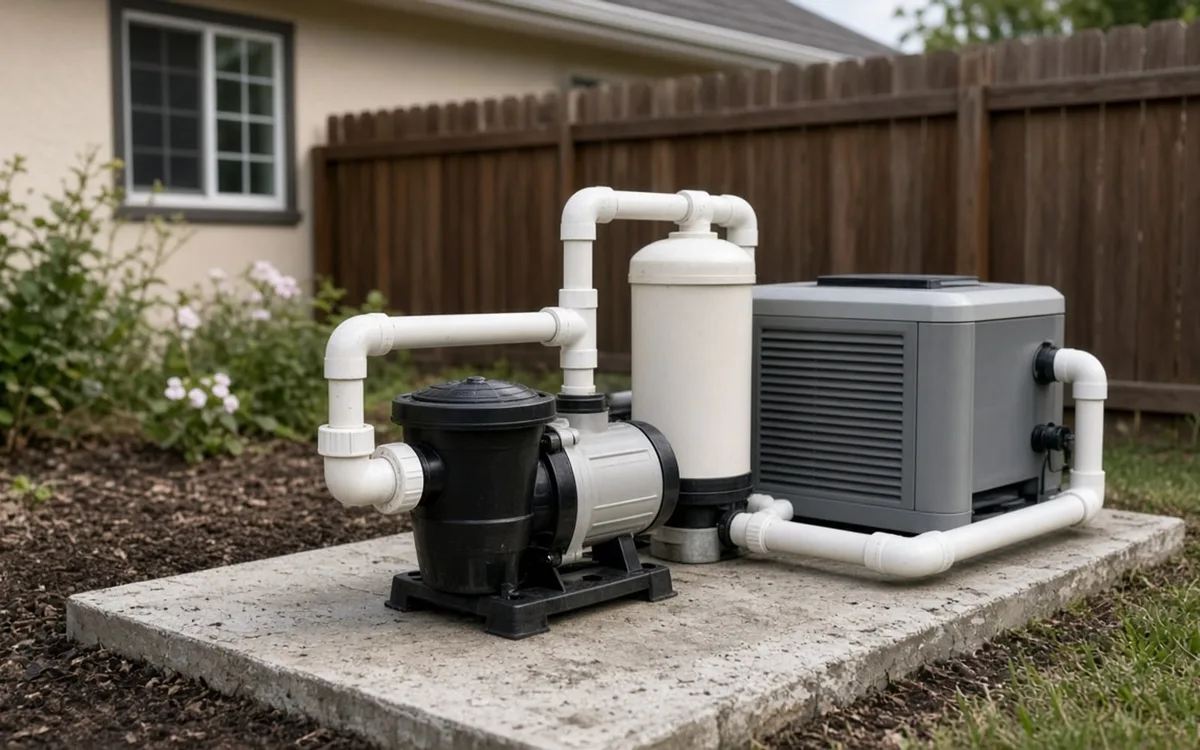
Pool Renewal Notes · Electric heat pump vs Natural gas heater
Choose a heat pump if you heat the pool steadily through a warm season, especially in the South, with a cover and a variable-speed pump. Choose gas if you heat a spa on demand, warm the pool only on weekends, or want spring and fall swimming in cool Northern air. Fixr puts heat pump running costs at $200 to $1,800 a year against $800 to $6,000 for natural gas.
Heater choice is the largest operating-cost decision on most pool pads after the pump. The purchase price gap between a heat pump and a gas heater is modest; the running-cost gap can be large, and it swings with climate, usage pattern and utility rates. Replacing a failed gas heater with another gas heater is the default, but not always the right answer.
This page compares the two by usage scenario, ten-year cost, climate, installation needs, resale and bid comparison. For sizing and electrical details, see the equipment upgrades page. The table on this page lines up the factors; the sections below apply them to common swimming patterns and climates. Running costs come from Fixr's 2025 guide.
A heat pump pulls heat from the air, costs more to buy and far less to run when the air is warm, and heats slowly. A gas heater costs less to buy, heats fast in any weather and costs several times more per season to run. HomeAdvisor's 2026 average install is $3,094; Fixr's operating range is $200 to $1,800 a year for a heat pump against $800 to $6,000 for gas.
| Factor | Electric heat pump | Natural gas heater |
|---|---|---|
| Upfront cost | $2,500 to $7,500 installed (HomeAdvisor 2026); 50-amp circuit | $1,500 to $6,000 installed (HomeAdvisor 2026); gas line sized for 200,000 to 400,000 BTU |
| Lifespan | Typically 10 to 15 years | 7 to 12 years (HomeAdvisor 2026) |
| Operating cost | $200 to $1,800 a year (Fixr 2025) | $800 to $6,000 natural gas; propane to $12,000 (Fixr 2025) |
| Heating speed | Slow; holds a set point with a cover | Fast; degrees per hour; ideal for spas and weekends |
| Climate fit | Efficient above about 50°F air; strong in the humid South | Any air temperature; needed for spring and fall in the North |
| Install time | A day plus electrical | A day plus gas line trenching |
| Resale / ROI | Low running cost is a selling point in warm markets | Neutral |
| Best for | Daily season extension in warm climates, covered pools, salt pools | Spas, weekend heating, cold or dry climates, fast recovery |
The heat pump wins in the Sun Belt and anywhere the pool is heated continuously through a warm season. With our analysis of EIA's 2024 survey showing 63.15% of Southern pool homes swimming year-round, the running-cost gap in Fixr's figures pays back the higher purchase price in two or three seasons, more so paired with a cover and a variable-speed pump on a long low-speed schedule.
Gas wins for a spa that must heat on demand, for a pool warmed only on weekends, and in Northern shoulder seasons when the air is too cool for a heat pump to keep up. Our EIA analysis found natural gas the most common heating fuel among pool homes that heat, at 15.8% of all pool homes nationally. If the old gas heater is past ten years, HomeAdvisor's advice to replace rather than repair is the moment to reconsider fuel; the equipment page covers sizing and the gas line.
A family that swims most evenings from April to October and keeps the pool at a steady temperature suits a heat pump: it runs slowly but continuously, and with a cover it holds the set point cheaply. An owner who swims mostly on weekends and lets the pool cool during the week suits gas, which raises temperature quickly on Friday and shuts off. A spa that must go from cool to hot in under an hour almost always needs gas. Our analysis of EIA's 2024 household survey found only 30.0% of hot-tub homes use the tub all twelve months, while 52.7% heat it with electricity.
Pools that are mostly unheated but occasionally warmed for an event also suit gas, since the heater sits idle most of the year. Idle time costs a gas heater nothing, while a heat pump earns its keep only when it runs for long stretches. Our analysis of EIA's 2024 survey found 60.1% of U.S. pool homes unheated and only 35.8% reporting a pool heating fuel, and for those adding a heater for the first time, the usage pattern should decide the fuel rather than the purchase price.
HomeAdvisor's 2026 installed average is $3,094, with heat pumps typically priced higher than gas units. HomeAdvisor lists heat pumps at $2,500 to $7,500 and gas at $1,500 to $6,000. Fixr's running-cost ranges, $200–$1,800 vs $800–$6,000 per year, dominate over a decade. Even at the low end of gas and the high end of heat pump, the gap can exceed the difference in purchase price within a few seasons of steady heating.
Installation extras change the picture. A heat pump may need a dedicated circuit and possibly a subpanel; a gas heater may need a new or upsized gas line and trenching from the meter. Those costs can exceed the price gap between units. HomeAdvisor gives gas heaters 7 to 12 years, so a gas unit may need replacing within the same decade, while a well-maintained heat pump often lasts longer. Include one replacement in the gas column if you plan to keep the house for ten years or more.
| Ten-year factor | Heat pump | Gas heater |
|---|---|---|
| Purchase and install | Higher unit cost; electrical work | Lower unit cost; gas line work |
| Annual running cost (Fixr 2025) | $200 to $1,800 | $800 to $6,000 natural gas |
| Replacement within ten years | Less likely | Possible (7 to 12 year life) |
| Heating speed | Slow and steady | Fast on demand |

Heat pumps pull heat from the air, so their output falls as the air cools. They work very well in warm, humid climates and less well on cool spring and fall evenings. In the South, where our EIA analysis found 63.15% of pool homes swim all year, a heat pump can run efficiently for most of the calendar. In the Northeast and Midwest, early and late season swims may exceed what a heat pump can deliver. Owners there who want May and September swims often keep gas or pair both.
Gas heaters work in any air temperature but burn fuel quickly. At high altitude, gas heaters lose capacity and should be sized accordingly. In dry, windy climates, a cover makes the biggest difference to either heater, since evaporation carries away most of the heat. Pairing either heater with a cover and a variable-speed pump is the most efficient setup. Wind breaks and a solar cover on cool nights help a heat pump most, since it cannot make up heat quickly.
A heat pump needs a dedicated electrical circuit sized to the unit, clear airflow around it and a location where fan noise will not bother neighbors or bedrooms. It may require a subpanel if the main panel is full. A gas heater needs a gas line sized for its demand, which is often much larger than for household appliances, plus venting clearances from windows, doors and property lines.
Both need a permit in most jurisdictions, and both must be plumbed so the pump delivers at least the heater's minimum flow. Ask the installer to confirm the minimum flow at the pump's programmed heating speed. With a variable-speed pump, the installer should program a speed that satisfies the heater when it is calling for heat. The permits guide explains the typical inspection steps for electrical and gas work.
Modestly. Buyers mostly want to know that the heater works and is not near the end of its life. In warm markets, low operating cost is a talking point for a heat pump. In cold markets, buyers may expect gas for spa use. A heater near the end of its life is a likely negotiation item either way.
If you plan to sell soon and the heater is failing, replacing it with the same fuel may be simplest. If you plan to stay, choose based on usage and climate, since the operating savings accrue to you. Keep the installation records and model information for the buyer. A heater with documented service is an easy item for an inspector to clear.
Undersizing a heat pump is the most common, which makes it seem ineffective in spring. Another is buying a heat pump for a spa expecting fast heating. With gas, the common mistake is ignoring the gas line size, leading to poor performance or a costly line upgrade after purchase. Many owners also skip a cover, which wastes much of what either heater produces. Finally, owners sometimes replace a heater without checking why the old one failed, such as low flow or poor water balance, and the new unit fails the same way.
Another mistake is replacing a failed heater without checking the pump. An old single-speed pump running long hours can cost more than the heater difference. ENERGY STAR notes an old pump can cost up to $310 per year, so review the pump at the same visit. The equipment cost guide covers combined pad budgets.
Compare model numbers and capacity in BTU, not just brand. Check that each installer sized the unit to your pool's volume, desired temperature rise and whether you use a cover. Look for electrical or gas line work as separate lines, and confirm permits and who pulls them. Ask about warranty terms, which may depend on installation by a registered dealer. A bid that lists only the unit price has not told you the installed cost.
Ask each installer to estimate annual running cost based on your usage pattern and local utility rates. If one bidder recommends a heat pump and another gas, ask each to explain why for your climate and usage. The better explanation usually comes with a running-cost estimate. Send your pad photos and usage notes through the estimate request to get comparable bids.
Homeowner polls
No votes yet. Yours will be the first. · saved on this device
No votes yet. Yours will be the first. · saved on this device
Yes, and some owners do: a heat pump maintains the pool cheaply and a gas heater fires the spa or a fast warm-up. Automation switches between them. It costs two units and two hookups, so it makes sense mainly where the spa is used often.
Sized to gallons, the temperature rise you want and how much the pool loses overnight; a cover halves the loss. Most residential pools use 100,000 to 140,000 BTU units. Undersizing is the common mistake because it makes the heat pump seem ineffective in spring.
In sunny climates with roof space, yes. HomeAdvisor prices systems at $2,500 to $9,500 with near-zero running cost and up to a 30-year life. It cannot heat at night or on demand, so it pairs with a backup rather than replacing one.
It can, slowly. A heat pump may take hours to bring a cool spa to temperature, which suits a spa kept warm continuously but not one heated on demand. Owners who use the spa spontaneously usually prefer gas. Some pair a heat pump for the pool with gas for the spa.
It has a fan and compressor, similar to an air conditioner condenser. Most are acceptable in a backyard but can bother neighbors or bedrooms if placed close. Check the unit's sound rating and place it thoughtfully. Local rules sometimes set minimum distances from property lines.
Usually, often much more per unit of heat. Fixr's 2025 guide shows propane operating costs reaching far above natural gas. Owners without natural gas service often find a heat pump more economical. Fixr puts propane as high as $12,000 a year for heavy use.
Often, if the location has adequate airflow and electrical service can be brought there. The old gas line should be capped properly. The plumbing connections are similar, but the electrical work may be significant. Ask for the circuit and any subpanel work as its own line.
A properly sized gas heater can raise a residential pool's temperature by a degree or more per hour, depending on pool volume and weather. A heat pump may take a day or more to achieve the same rise. That difference is why usage pattern matters more than price.
A cover reduces heat loss so much that it can change which heater is practical and how large it needs to be. Consider the cover first, then size the heater for a covered pool. Fixr prices automatic covers at $3,594 to $10,782; manual solar covers cost far less.
 ComparisonStandard plaster vs Pebble aggregate
Choose plaster when you expect to sell within a few years, want the smoothest feel or have a fixed budget; choose pebble when you will keep the pool for a decade or more, live with freeze-thaw or hard water, or want fewer drain cycles.
 ComparisonReplaster only vs Coordinated remodel
Replaster alone when the interior is the only diagnosed problem and the tile, coping, deck and equipment are sound.
 ComparisonResurface the deck (overlay) vs Replace the deck
Resurface a pool deck when the slab is flat, drains away from the house and pool, and has only surface wear or hairline cracks.
ComparisonConvert to saltwater vs Stay on chlorineConvert to salt when the pool has a long season, compatible heater and fixtures, and salt-tolerant coping, and when you value softer water and fewer chemical purchases.
ComparisonWaterline retile only vs Full interior retileRetile only the waterline when the interior finish is sound and the goal is to fix popped, scaled or dated tile; it costs Shasta Pools' $25 to $30 per linear foot with the water lowered, not drained.
 Service guidePool Resurfacing
Pool resurfacing replaces a worn interior finish on a concrete pool with new plaster, quartz, pebble aggregate or tile, or replaces the liner on a vinyl pool.
 Service guideTile & Coping Replacement
Tile and coping replacement renews the waterline band and the edge cap on the bond beam after the cause of the failure is understood.
 Service guideEquipment Upgrades
Equipment upgrades replace or add the pump, filter, heater, sanitizer, lights, automation and safety hardware on an existing pool.
 Service guideComplete Pool Remodel
A complete pool remodel coordinates several diagnosed repairs and desired changes, typically interior finish, tile and coping, deck, equipment and features, into one sequence with one drain cycle and one contractor accountable.
 Free toolPool resurfacing and renovation cost calculator
Size, material tier and complexity in, a realistic budget range out.
 Free toolPool renovation quiz: nine facts to know before the first proposal
9 questions that show what you already know and what to check next.
 Free toolPool renovation polls
See what other planners chose and add your vote.
Tell us the size, the condition of what is there now, and what you want to change. Pool Renewal Notes passes your request to independent local professionals, who reply with written, no-obligation estimates. The service is free to use.